A data-governance operations platform that turns ownership, controls, evidence, and workflows into daily operational work.
Domain: Data governanceSystem: Enterprise web platform
Product
Data Governance Operations Platform
Presentation
Scoped technical case study
Stack
Angular, NestJS, Prisma, PostgreSQL
Focus
Governance operations, evidence, workflow, access
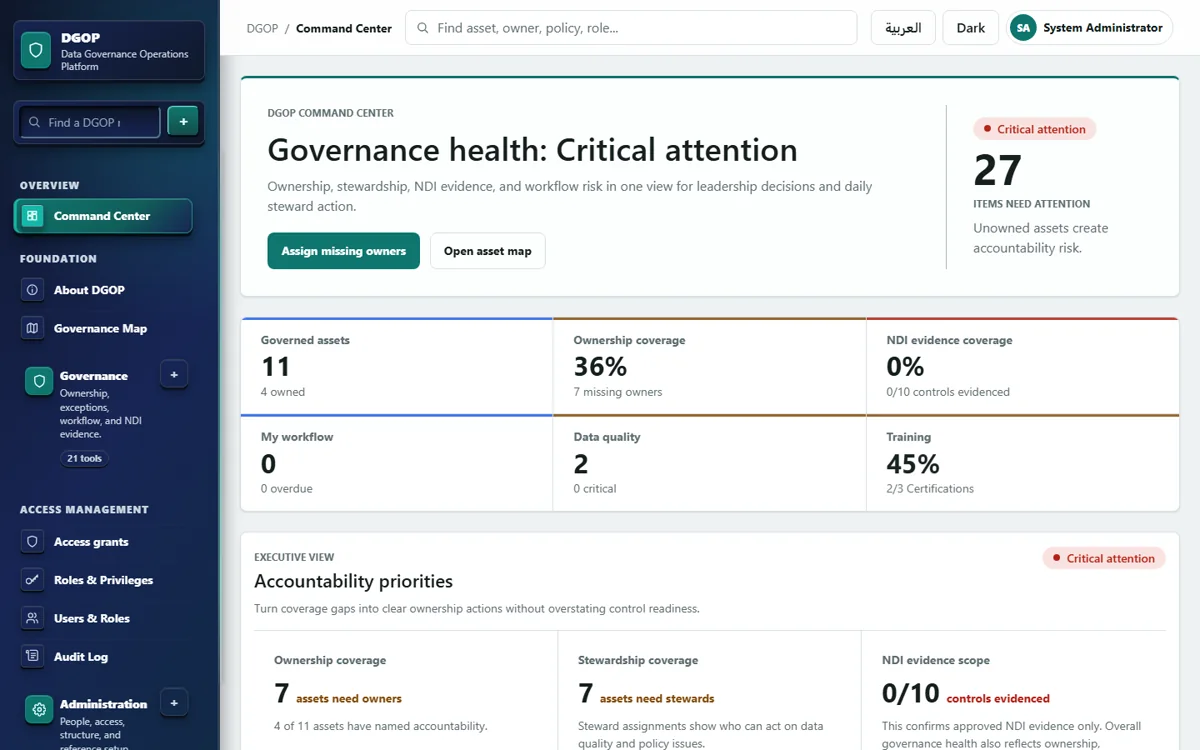
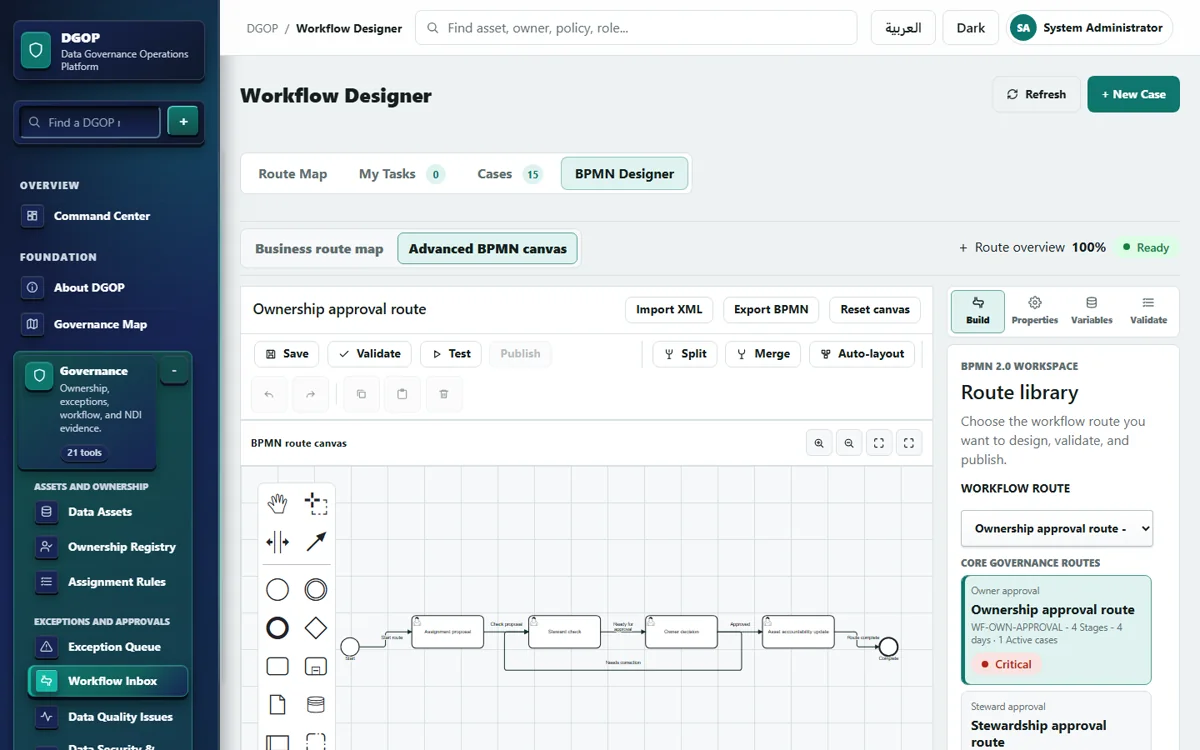
Command Center and workflow design surfaces from the working platform.
Summary
DGOP is an end-to-end platform for operating data governance beyond policy documents. It brings data assets, ownership, stewardship, access, evidence, privacy, quality, and approval work into one controlled application.
Goal: Give governance teams a shared operational system for decisions, accountability, and evidence.
Approach: Connect domain workspaces through permissions, workflows, audit events, and a consistent enterprise interface.
Delivery: Build the product as a bilingual Angular application backed by NestJS, Prisma, and PostgreSQL.
Platform Capabilities
Governed data assets, ownership assignments, and stewardship coverage.
Access grants, roles, users, effective access, and review queues.
Workflow cases, tasks, evidence attachments, approvals, and BPMN route design.
Data quality, NDI readiness, open data, privacy, FOI, training, and data-sharing workspaces.
Immutable audit history, scoped permissions, English/Arabic direction, and accessible themes.
System Decisions
The interface is organized around daily decisions rather than feature marketing. Shared grids, filters, dialogs, status language, and permission-aware states keep dense governance work predictable across the platform.
Traceability: Operational actions connect to workflow and audit evidence.
Adaptability: Semantic tokens support light, dark, high-contrast, English, and Arabic experiences.
Evidence
The implementation includes Angular and NestJS applications, a Prisma data model and migrations, automated tests, browser checks, release QA material, and operational documentation. Screenshots use local synthetic data and expose no production credentials.